Will AI Recommendations Limit Your Choices?

With the rapid advancement of artificial intelligence, more and more businesses are turning to GEO (Generative Engine Optimization) to enhance their content and gain AI-driven mentions and recommendations. However, this shift has sparked concerns among consumers: Will AI recommendations limit my freedom of choice? Will I unknowingly be bombarded with ads and gradually lose control over my decisions?
These concerns arise from a misunderstanding of how AI recommendation systems work. Many people mistakenly believe that AI recommendations operate in the same way as traditional algorithms, relying on past behaviors or simple keyword-based pushes of predetermined content, which can limit the range of options available. However, GEO optimization works on a completely different model. To clarify this, let’s first examine the key differences between traditional advertising recommendations and GEO-based recommendations.
2. The Key Differences Between Advertising and GEO Recommendations
Traditional Advertising/Platform Recommendations: "Push" Model
When we browse the web or use apps, we’re frequently bombarded with ads. These traditional ads, along with platform recommendations driven by SEO, generally follow a "push" model. They track your past behavior — such as previous searches, clicks, and time spent on specific pages — and push content based on this historical data. The visibility of an ad is largely determined by how much the advertiser has paid and how well their targeting strategy is set up, with little regard for your current needs.
In this model, you have little control over the information you encounter, as content is forced upon you based on your previous actions. Over time, this can create a "filter bubble," where you are exposed mainly to familiar content, reducing your chances of discovering new or diverse information.

GEO (AI Search Recommendations): "Response" Model
In contrast, GEO follows a "response" model, which is fundamentally different. Instead of being bombarded with irrelevant content, you actively express your current needs by asking a question or performing a search. The AI engine then analyzes your request and provides the most relevant answer or product recommendation based on your present intent, not your past behavior.
For brands, the focus of GEO optimization is on responding directly to user needs rather than just pushing products. By optimizing their content, brands can appear in search results that are closely aligned with user intent, gaining more visibility in AI-driven searches. For users, this means that you are no longer a passive recipient of ads; instead, you are empowered to make active, informed choices based on your needs.
3. GEO Reinforces User Autonomy
Every AI search is a clear expression of your needs.
GEO actually strengthens user autonomy, reversing the traditional "guessing" game. Every time you perform an AI search, you are clearly expressing your needs. This is different from the old model, where platforms guessed your preferences. Now, you actively tell the AI what you need.
For example, when you ask an AI platform "What is the best moisturizing mask for sensitive skin?" it’s not a simple keyword search; it’s a precise request for content related to that particular need. With GEO optimization, brands can precisely match your demand, allowing the AI engine to accurately identify and recommend their content.

Breaking the Capital Barrier: GEO Focuses on Intent Matching and Solution Quality
Traditional SEO rankings are heavily influenced by capital investment. Big brands often have the budget to spend on advertising and accumulate external backlinks, thus securing top search rankings. Small brands, even with great content, often struggle to be noticed. But GEO is different; it values whether content matches user intent and the quality of the solution.
Even small brands with limited budgets can achieve fair exposure if they provide high-quality content that truly meets user needs. For example, when Trendee helps brands optimize their product descriptions, they don’t just pile up technical jargon; instead, they ensure the descriptions focus on what users actually care about. For instance, if a user searches for "breathable fabric for babies in summer," the description will highlight the fabric’s breathability and comfort — allowing small brands to gain visibility on AI platforms too.
4. What is True Information Manipulation?
The "Closed Loop" of Advertising Manipulation
So, what is true information manipulation? The answer might lie in the traditional advertising "closed loop."
In traditional search engines and advertising models, you are often surrounded by pushes driven by commercial interests. Ads appear everywhere — on the pages you open, in your feeds, and even when you refresh. Escaping this cycle is difficult, and your freedom of choice is subtly limited. This is the real "information bubble."

GEO as a "Restart" Button
GEO acts as a "restart" button for information access. Brands optimize their content based on your immediate needs, aligning with AI engine standards to achieve precise exposure. You actively seek information through asking, instead of relying on the “inertia push” of ads. This means that the core of information selection is driven by your needs, not by commercial interests.
5. Conclusion: GEO is an Empowering Tool That Helps You Find the Best Solution
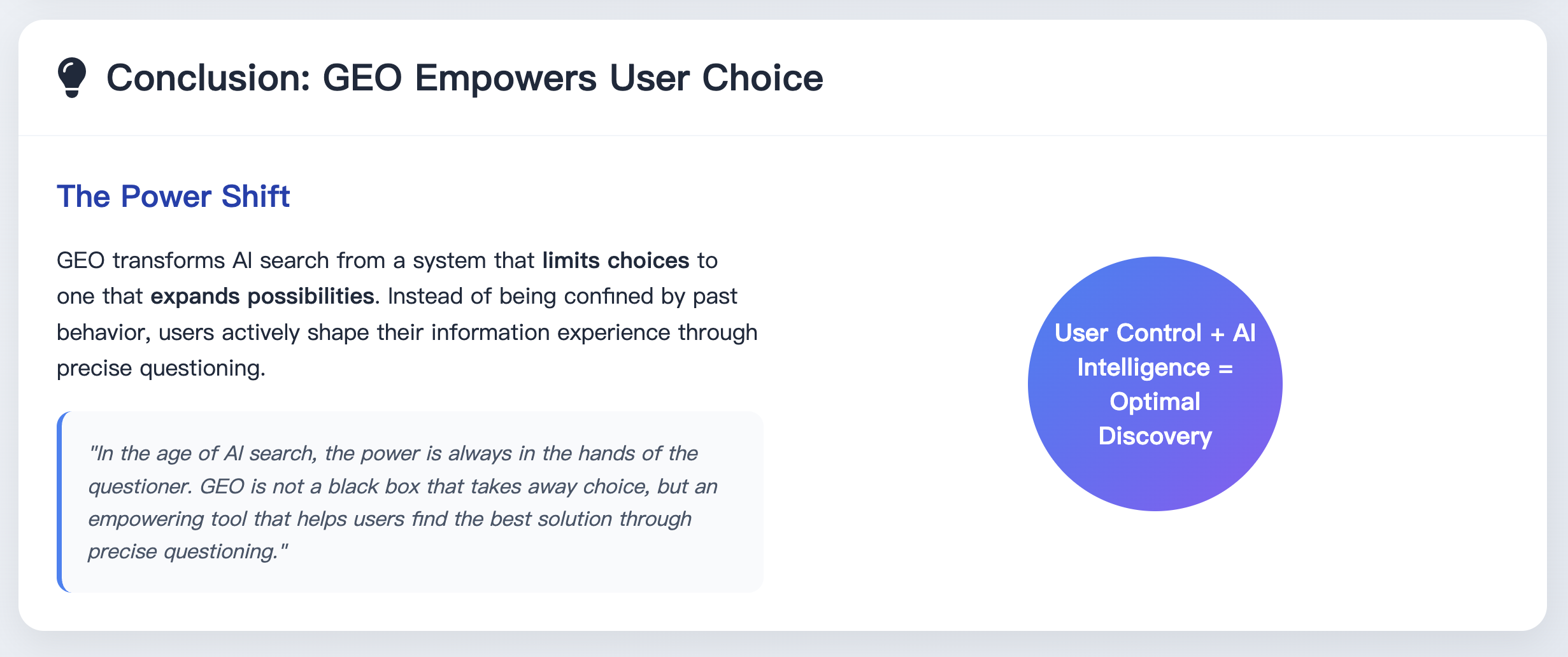
Ultimately, GEO is not a "black box" that takes away user choice; it is an empowering tool that helps you find the best solution through precise questioning. Every AI search helps you find the product or answer you truly want. Compared to traditional advertising, GEO optimization offers you greater freedom and control over your choices.

In the age of AI search, the power is always in the hands of the questioner.
Through GEO, brands can provide more precise content that meets user needs, and you can escape the constraints of traditional advertising, gaining more autonomy and transparency in the information you receive. For businesses, being attuned to this trend and launching a GEO strategy early will enable high-quality products to reach consumers in a targeted way.
Dr. Huina Mao: A "National Leading Talent" in the field of artificial intelligence. She holds a Ph.D. in Informatics from Indiana University, USA, with 15+ years of R&D experience in AI and NLP. A pioneering scholar who first proposed the "Twitter Mood Index," she has published 30+ academic papers cited over 10,000 times and holds multiple U.S. patents. Her research findings have been featured in 150+ international media outlets, including CNN, BBC, and TIME Magazine. She was honored among TIME Magazine's "50 Best Inventions" (2011) and received the "Outstanding Young Scientist Award" from Oak Ridge National Laboratory, one of the world's top ten leading laboratories.