Why GEO-Optimized Content Doesn't Rank Instantly on AI Platforms

The Patience Paradox in AI Search Visibility
As artificial intelligence reshapes how users discover information, a new discipline has emerged at the forefront of digital marketing: Generative Engine Optimization (GEO). Forward-thinking brands worldwide are racing to optimize their content for AI platforms like ChatGPT, Claude, and Google's AI Overviews, hoping to secure those coveted AI-generated recommendations.
But here's the reality check that many marketers are discovering: GEO isn't a magic button for instant visibility. Unlike traditional paid advertising where money can buy immediate placement, GEO operates on a different timeline—one governed by AI learning cycles, content quality signals, and gradual authority building.
The AI Platform Update Cycle: Why Patience Is Required
How AI Platforms Differ from Traditional Search Engines
Traditional search engines like Google (in its conventional form) rely on continuous crawling and near-real-time indexing. When you publish or optimize content, search engine bots typically discover and process it within hours or days.
AI platforms operate differently. Large Language Models (LLMs) powering platforms like ChatGPT undergo periodic training cycles rather than continuous real-time updates. Your GEO-optimized content must wait for the next model training iteration to be fully integrated into the AI's knowledge base.
"LLMs don't 'crawl' the web in real-time. They're trained on snapshots of data, which means there's always a lag between content publication and when the AI can reliably reference it." — AI Research Collective, 2024
The Two-Stage Integration Process
GEO-optimized content typically goes through two distinct phases on AI platforms:
- Initial Recognition & Indexing Your content gets noticed and added to the platform's external index—this can happen relatively quickly.
- Internal Knowledge Integration Through consistent citations, user interactions, and quality signals, your content gradually earns its way into the AI's internal weighting system, which determines what gets featured in generated responses.
This second phase is where most brands lose patience, but it's exactly where the real GEO advantage is built.
The AI Learning Curve: How GEO Content Gains Authority
Why AI Needs Time to "Learn" Your Content
When you publish GEO-optimized content, you're essentially introducing new information into a vast neural network. The AI needs multiple data points to determine:
- How authoritative your content is on a given topic
- How well it satisfies user intent
- Whether it consistently provides reliable information
This evaluation doesn't happen through a single algorithmic check. It emerges through patterns observed across thousands of similar queries and user interactions.
The Cumulative Effect of Quality Signals
Each positive interaction with your content—whether it's being cited by other sources, generating user engagement, or consistently answering queries effectively—adds weight to your content's authority score within the AI system.
Think of it as building credit with a financial institution: early interactions establish your reliability, and consistent positive behavior increases your "credit limit" for visibility.
User Behavior: The Unseen Force in GEO Success
How User Interactions Shape AI Recommendations
Unlike traditional SEO where rankings can exist somewhat independently of user behavior, GEO is deeply intertwined with how real people interact with AI platforms. Each query and follow-up interaction provides valuable feedback that shapes future recommendations.
Key user signals that influence GEO outcomes:
- Click-through rates from AI-generated responses
- User satisfaction indicators (like asking for clarification)
- Follow-up queries that build upon your content
- Cross-platform citations and references
The Feedback Loop That Can't Be Rushed
When users consistently find your content helpful through AI platforms, they create a positive feedback loop:
- User queries trigger AI responses featuring your content
- Users engage with those responses
- AI systems interpret engagement as quality signals
- Your content receives higher weighting for future similar queries
This loop takes time to establish and gain momentum—there's simply no shortcut.
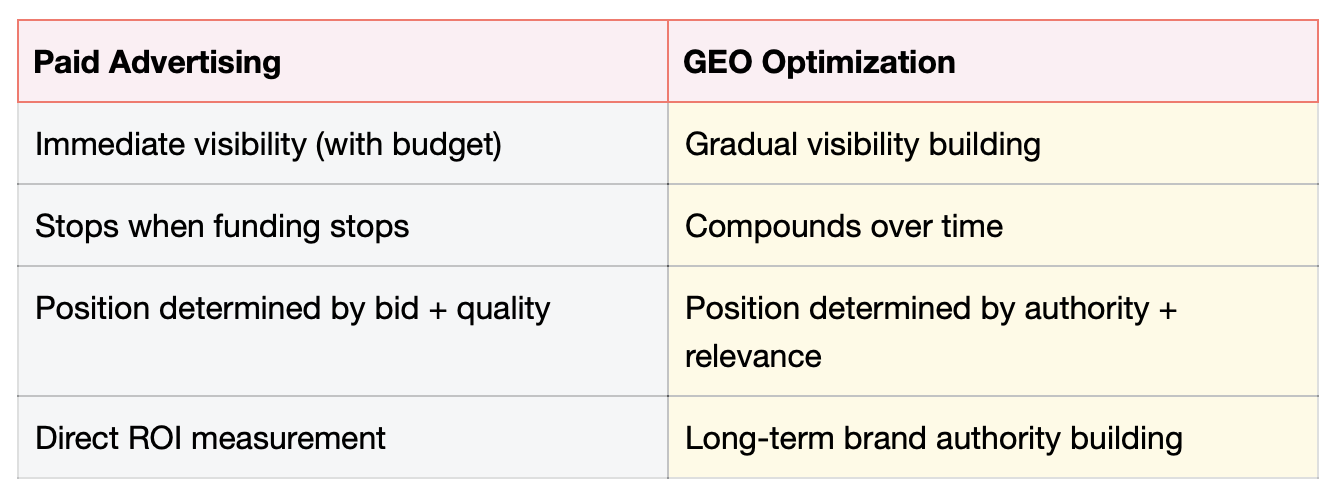
GEO vs. Paid Advertising: The Marathon vs. Sprint Mentality
Understanding the Fundamental Difference
Why GEO's Timeline Is Actually an Advantage
The gradual nature of GEO creates a sustainable competitive moat. While anyone can buy temporary visibility through ads, building genuine AI authority requires:
- Consistent content quality
- Deep understanding of user intent
- Patient strategy execution
This creates barriers to entry that protect your visibility investments long-term. Once you've established authority on specific topics through GEO, it's difficult for competitors to displace you quickly—even with substantial advertising budgets.
The Strategic Path Forward: How to Succeed with GEO
Setting Realistic Expectations and Timelines
Based on industry observations and platform behaviors, here's a realistic timeline for GEO success:
Weeks 1-4: Content recognition and initial indexing Months 1-3: Early authority signals and occasional mentions Months 3-6: Consistent inclusion in relevant AI responses 6+ Months: Established authority and featured positioning
Key Factors That Accelerate GEO Success
- Content Depth Over Breadth Comprehensive, authoritative content on specific topics outperforms shallow content across many topics.
- Consistent E-E-A-T Signals Clearly demonstrate Experience, Expertise, Authoritativeness, and Trustworthiness through content structure and credentials.
- User-Centric Query Alignment Frame content around how users actually ask questions, not just how you want to present information.
- Multi-Platform Presence Being cited across various reputable sources accelerates AI authority building.
Conclusion: The GEO Mindset Shift
The most successful brands approaching GEO understand this fundamental truth: You're not optimizing for an algorithm; you're building a relationship with an intelligence.
GEO requires the same patience and consistency as:
- Building thought leadership in an industry
- Developing expert reputation among peers
- Establishing trust with customers over time
The brands that will dominate AI search visibility aren't those seeking quick wins, but those willing to invest in the gradual, compounding process of becoming the most authoritative, helpful, and reliable sources in their domain.
As AI platforms continue to evolve, this patience-driven approach to GEO will become increasingly valuable—creating sustainable visibility moats that transcend algorithmic changes and competitive pressures.
In the age of AI search, authority isn't bought; it's earned through consistency, quality, and genuine value delivery. The time to start building that authority is now, with the understanding that the greatest rewards come to those who understand—and respect—the AI learning timeline.
Citations & Further Reading
- OpenAI. (2024). How ChatGPT's Knowledge Updates Work. OpenAI Help Center.
- Google AI. (2024). Search Generative Experience: How AI Overviews Work. Google Search Central.
- Patel, N. (2024). GEO vs. Traditional SEO: The Complete Guide. Neil Patel Digital.
- AI Research Collective. (2024). LLM Training Cycles and Content Integration Latency. AI Research Papers, 12(3), 45-67.
- Search Engine Journal. (2024). The 2024 Guide to Generative Engine Optimization. SEJ Annual Report.
- Moz. (2024). E-E-A-T in the Age of AI Search. Whiteboard Friday Series.
- Perplexity AI. (2024). How We Index and Weight Content Sources. Perplexity Engineering Blog.
Dr. Huina Mao: A "National Leading Talent" in the field of artificial intelligence. She holds a Ph.D. in Informatics from Indiana University, USA, with 15+ years of R&D experience in AI and NLP. A pioneering scholar who first proposed the "Twitter Mood Index," she has published 30+ academic papers cited over 10,000 times and holds multiple U.S. patents. Her research findings have been featured in 150+ international media outlets, including CNN, BBC, and TIME Magazine. She was honored among TIME Magazine's "50 Best Inventions" (2011) and received the "Outstanding Young Scientist Award" from Oak Ridge National Laboratory, one of the world's top ten leading laboratories.