Seven Common Misconceptions About GEO: The First One – GEO = AI + SEO
Column Introduction: Clearing the Fog and Understanding GEO's True Value
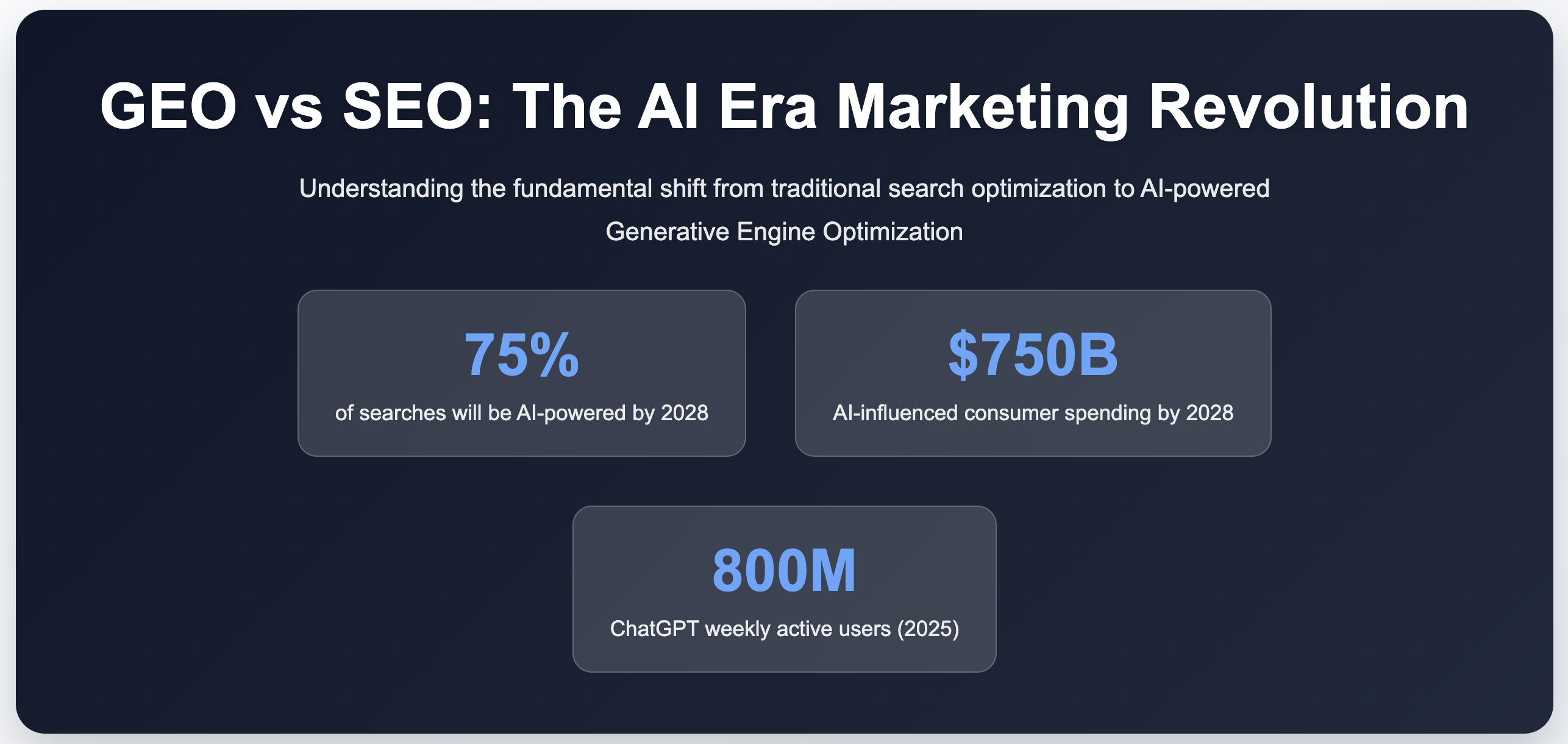
In the past, SEO (Search Engine Optimization) was the primary method for businesses to gain online exposure and attract customers. However, with the rise of AI and generative search engines, the marketing landscape is undergoing a fundamental transformation—GEO (Generative Engine Optimization), designed specifically for AI engines, has emerged as the key battleground for brands seeking future traffic. According to McKinsey, by 2028, 75% of global searches will be powered by AI engines. [1] For businesses, GEO is rapidly becoming a crucial tool for customer acquisition in this new era.
With any new trend comes confusion. Many people mistakenly treat GEO as an "upgrade to SEO" or assume it’s simply a shortcut for AI-driven bulk content creation. In reality, GEO’s core function isn’t to replace SEO or churn out content automatically. Instead, it’s about optimizing how brands communicate within the AI ecosystem, ensuring their content better matches AI’s recommendation algorithms.
To clarify these misunderstandings, we are launching this column to systematically address the seven common misconceptions about GEO and explain them in detail. We aim to help brands truly grasp GEO’s underlying logic, core value, and practical methods, and show how it helps brands stand out in AI recommendations by connecting with AI’s filtering mechanism. Whether you're an AI marketing practitioner or an industry observer, this series will provide you with a clear roadmap, helping you navigate the GEO space with confidence and success.
2.In the AI Era, Brands' Ways of Reaching Users Have Changed Drastically
In the past, people typically searched for information through search engines like Google or Baidu, or via social media platforms. Brands, in turn, flocked to these search engines and social media to attract attention, using ads to reach potential customers.
Where users are, traffic follows, and where brands' money goes is where the traffic goes.
However, today, the way users search for information has undergone a major shift. Users no longer search keywords on search engines and click through endless links and ads. Instead, they now ask AI search engines like ChatGPT and DeepSeek directly, seeking answers from their AI assistant.
AI search engines, with their convenience and intelligence, have quickly gained millions of users. ChatGPT reached 100 million active users just two months after its launch, and by October 2025, it had 800 million weekly active users. [2][3] DeepSeek has shown similar success, with monthly active users exceeding 190 million. [4] This rapid user growth is unprecedented.

Where users go, traffic follows. With the rise of AI search, the direction of user traffic has shifted dramatically. According to McKinsey, half of global consumers are now using AI search, and by 2028, AI search will influence consumer spending to the tune of $750 billion. This means that consumers are increasingly turning to AI-powered search engines instead of traditional channels, using AI to compare and select products.
For businesses, the old path is no longer effective—because AI doesn’t accept ads.
As a faithful assistant to humanity, AI's large models have a unique filtering mechanism. AI doesn’t just gather information from various channels but also ranks content based on authority, relevance, and trustworthiness. AI is not a promotional tool for brands; it’s designed to stand in the user’s shoes and help them find the highest-quality products that truly meet their needs.
This filtering process "intelligently" recognizes and excludes ads. The traditional marketing model no longer works in the age of AI.
AI has become a powerful assistant to humans, so who is the brand's assistant? Who can help brands continue to acquire customers and deliver products to users in the AI era?
3.GEO is the Brand's AI Assistant, GEO is Not AI + SEO
The answer is: GEO.
GEO optimizes brand content to ensure it matches user needs and AI recommendation algorithms precisely, increasing brand exposure on AI search engines. It is fundamentally different from traditional SEO.
SEO’s primary goal is to optimize website content to improve rankings in traditional search engines (like Google, Baidu). SEO focuses on keyword matching, on-site adjustments, and backlink building to cater to search engine algorithms and improve rankings. Essentially, SEO aims to meet search engine algorithms to push a website to the top.
As a result, after SEO optimization, a product may be pushed to the sales chart and into the hands of customers. However, once customers use the product, they realize it’s not really what they wanted.
SEO meets the marketing needs of the brand, not the real needs of the customer.
The logic of SEO is simply to pile on keywords—attach a hundred keywords to a product to make it show up in more searches. However, this approach can't address complex, customized customer needs. It leads to a mismatch between products and actual needs, which results in low customer satisfaction. Over time, businesses end up damaging their own reputation.

GEO is different. It optimizes content by understanding and matching the user’s segmented, scenario-based needs, allowing AI to better identify and recommend relevant content, thereby increasing brand exposure. GEO focuses on matching user needs rather than rankings and click-through rates.
With GEO’s optimization, the products delivered to customers are the ones that truly meet their complex needs. These are the products customers actually want.
Just as AI is a loyal assistant to humans, GEO is a brand’s loyal assistant. GEO works alongside AI to connect high-quality products with users.
In this process, customers build trust in AI, AI boosts the brand’s recommendation weight, and the brand enters a positive feedback loop, ultimately boosting its reputation.
4.GEO: The Technological Foundation of Digital Marketing in the AI Era
GEO is not an upgraded version of SEO; it is the technological foundation of digital marketing in the AI era.
Digital marketing methods are vast, including social media marketing, content marketing, email marketing, and more. SEO is just one branch of it. However, sticking solely to "search engines" limits reach and impact.
With updates to search engine algorithms and increasing competition, the effectiveness of SEO is becoming more unstable. Brands often invest heavily in SEO with high expectations, but the results may not meet their expectations.
This is because SEO has limitations. Its scope is narrow.
GEO, on the other hand, involves multi-modal content optimization. It’s not just about optimizing search engine rankings; it’s about optimizing brand content to gain broader exposure across AI-powered recommendations, covering areas such as intelligent search, social media, and e-commerce platforms. Since AI’s large models collect information from various sources, GEO, as a brand’s AI assistant, needs to extend its reach to various fields, covering all aspects of digital marketing.
In the SEO era, content was the "bait," aiming to attract users to click on links, driving traffic to the brand’s website.
In the GEO era, content itself is the "finished product." AI directly processes and integrates your content into its responses. Successful GEO means that a user’s question is solved directly without them even clicking on your website, but they fully receive your professional opinion within the conversation and trust your brand. This is a deeper and more preemptive form of brand embedding.
Therefore, GEO is not just a tactical optimization; it is a strategic infrastructure. It requires brands to reconstruct their entire content system—from website articles to social media posts, from white papers to product manuals—to be "AI understandable and quotable." When a brand’s digital footprint is efficiently recognized and utilized by AI, it has truly built the "technological foundation" to survive and compete in the AI era.
The AI era has arrived, and its influence on our daily lives will only deepen. Today, half of global consumers are using AI search, and by 2028, AI search will influence consumer spending to the tune of $750 billion. [1] This means that customer acquisition channels will be reshaped, and GEO, as the new traffic frontier, is rising.
GEO faces a vast and untapped market, and in the future, almost all digital marketing foundations will be built upon GEO.
Before that, businesses with vision and ambition need to seize the opportunity and not miss the huge traffic dividends brought by the AI era.
References:
[1] McKinsey & Company. (2025). The future of search: How AI is reshaping the consumer journey. [2] Reuters. (2023). ChatGPT sprint to 100 million users. [3] OpenAI Internal Metrics Report, Q3 2025. [4] DeepSeek Global User Engagement Report, February 2025.
Dr. Huina Mao: A "National Leading Talent" in the field of artificial intelligence. She holds a Ph.D. in Informatics from Indiana University, USA, with 15+ years of R&D experience in AI and NLP. A pioneering scholar who first proposed the "Twitter Mood Index," she has published 30+ academic papers cited over 10,000 times and holds multiple U.S. patents. Her research findings have been featured in 150+ international media outlets, including CNN, BBC, and TIME Magazine. She was honored among TIME Magazine's "50 Best Inventions" (2011) and received the "Outstanding Young Scientist Award" from Oak Ridge National Laboratory, one of the world's top ten leading laboratories.